

 What Is a Closed Work Permit?
- What Is an Open Work Permit?
- What Is a Spousal Open Work Permit?
- Eligible Workers
- International Students
- Permanent Resident Sponsors

Date: August 26, 2026
 What Is a Closed Work Permit?
A Closed Work Permit is an employer-specific work permit that strictly outlines all fixed requirements that surround the work to be performed. For example, the permit indicates the employer, pay rate, job type and duties, work location, and how long the permit is valid for. Those details then become Immigration Policy Rules of the Permit that must be followed.
To apply for the closed work permit, a job offer is required. Most closed work permits require a Labour Market Impact Assessment (LMIA). The purpose of a LMIA is to safeguard work for Canadians by ensuring that there isn’t a qualified Canadian worker to fill the job offer.
It is important to check the NOC and TEER category of the target job to ensure it isn’t LMIA exempt. For example, employers can bypass the traditional LMIA process for Computer Programmers (NOC code 21230, TEER 1) because of the in-demand nature of these highly skilled roles.
What Is an Open Work Permit?
An Open Work Permit (OWP) is characterized by the advantages it offers the foreign worker in Canada. For example, the permit doesn’t require indicating the employer details on the form IMM5710 – Application to Change Conditions, Extend my Stay or Remain in Canada as a Worker.
The applicant doesn’t have to disclose who they’re working for and are eligible for almost any employer. IRCC does contain a blacklist of Canadian Employers that are ineligible to be used as employers for OWPs because of a non-compliant immigration history with IRCC.
For example, a decision of ineligibility for the employer Blue House Organics Inc. was made on May, 2026. Blue House Organics was fined $387,500 CAD and given a 2 year ban. The employer couldn’t prove the job description was true, broke hiring and recruiting laws, and the pay and working conditions didn’t match the job offer.
OWPs are flexible in that they don’t require a job offer or LMIA so they are faster to process.
What Is a Spousal Open Work Permit?
A Spousal Open Work Permit (SOWP) is a special privilege afforded to applicants applying for family immigration in Canada.
Many of Lawseph clients are families that go through multiple immigration applications as stepping stones on their way to Permanent Residence (PR) in Canada.
For example, a recent client entered Canada with his wife as an International Student on a Study Permit and the wife on an Open Work Permit. They reached out to us at downtown Richmond St. W. Toronto to assist in the extensions of their work permits, LMIA Employer Guidance, and an OINP Expression Of Interest (EOI) for the main applicant of NOC 22311 Electronic system tech.
They gave birth to a son in Ontario who became a full Canadian Citizen on his birthday.
Successful approval of immigration applications rely heavily on well timed submissions and ahead of time preparation and requirements gathering. Who gets approved for an OWP depends on certain eligibility requirements in Ontario.
Eligible Workers
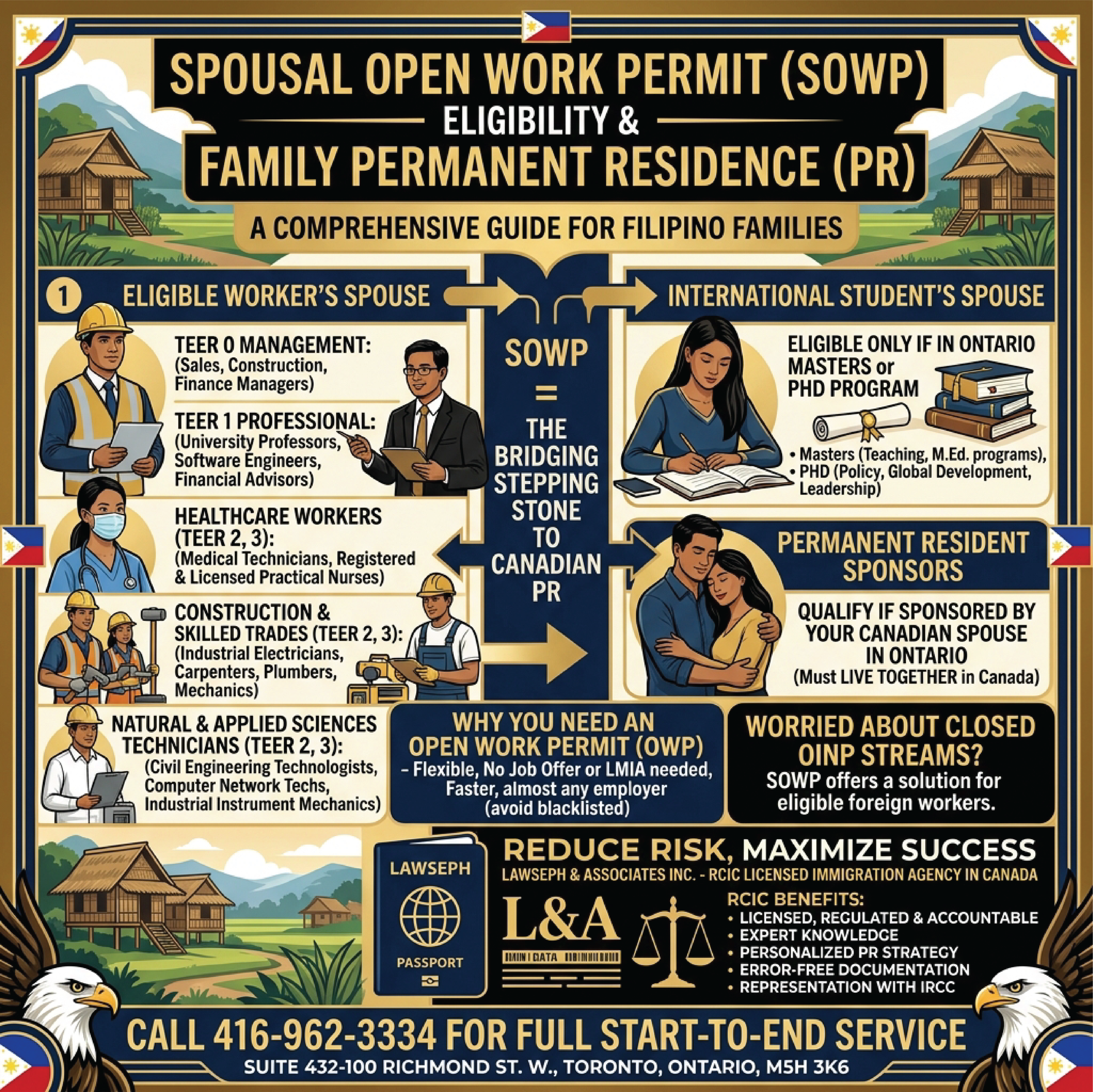
The recipient of an SOWP stemming from the ongoing application of an eligible worker can be afforded to a spouse, common-law, or conjugal partner. The relationship will need to be proved with official documentation as a requirement for successful submission of a complete application in the Temporary Resident (TR) Portal.
 TEER 0 Management Occupations
At the top of the list is TEER 0 management occupations which can extend the privilege of a SOWP to their spouse. They might work in sales, construction, or the financial industry.
TEER 1 Professional Occupations
Second winner on the list are professional occupations such as university professors, software engineers, and financial advisors.
TEER 1 occupations are at the sweet spot for OWP Eligibility where all spouses of these applicant foreign workers in any of the categories residing under the TEER 1 type get a free pass on meeting any other eligibility criteria and go straight to work.
Healthcare Workers in Select TEER 2 and TEER 3 Occupations
Number 3 on the list goes to healthcare workers in TEER 2 and 3 occupations in high-demand which include medical technicians, registered and licensed practical nurses.
Construction and Skilled Trades Workers
Second last on the list are Construction and Skilled Trades Workers in Select TEER 2 and TEER 3 occupations.
For example, there’s a priority list with its sights on Industrial electricians, carpenters, plumbers, and heavy-duty equipment mechanics which can afford the applicant’s spouse a fast processing OWP.
Natural and Applied Sciences Technicians
Last on the list on number 5 is Natural and Applied Sciences Technicians grouped under TEER 2 and TEER 3 labels.
These select occupations include Civil engineering technologists, computer network technicians, and industrial instrument mechanics.
International Students
The applicant as an international student must be in a Masters or PhD program in Ontario to extend the privilege of an SOWP to their spouse.
A top list of Masters programs in Ontario that International Students complete in Ontario include:
- Master of Teaching (M.T.)
- M.Ed. in Curriculum & Pedagogy (Online Teaching & Learning)
- M.Ed. in Language Teaching (Language & Literacies Education)
- M.Ed. in Educational Leadership and Policy / Higher Education
- General Master of Education (M.Ed.)
The PHD programs typically chosen by doctoral students are topics of policy, global development, and leadership.
For example:
- Higher Education
- Educational Leadership and Policy
- Comparative, International and Development Education (CIDE)
- Curriculum and Pedagogy
- Social Justice Education
Permanent Resident Sponsors
If you are being sponsored by your Canadian spouse, you can qualify for a Spousal Open Work Permit (SOWP) in Ontario. To qualify, the spouse must be living with their Canadian sponsor in Canada.
For example, we have a client who came to Canada on a visitor visa and met her wife in Toronto, Ontario where they fell in love and moved in together.
As time went on, the spouse became eligible for an SOWP to start earning money. Because she was being sponsored for Permanent Residency (PR) she reached out to Lawseph at downtown Richmond St. W. for assistance with the processing of her SOWP.