

- Understanding the Humanitarian and Compassionate Application
- The Challenge of Demonstrating Establishment While on Visitor Status
- Best Interests of the Child Considerations
- Demonstrating Social, Community, and Personal Establishment
- Living With Canadian Family Members in Toronto
- Family Grief and Emotional Support
- Financial and Educational Support for the Client’s Son Overseas
- Potential Impact of Removing the Client From Canada
- Documenting the H&C Justification

Date: September 14, 2026
Understanding the Humanitarian and Compassionate Application
We are currently processing an In-Canada Humanitarian and Compassionate (H&C) application for a Filipino client who reached out to Lawseph & Associates Inc. at our office at 100 Richmond St. W. in downtown Toronto, across from Nathan Phillips Square.
An H&C application shares many information requirements with other Canadian immigration applications. Applicants are generally required to provide detailed information concerning their personal history, employment, education, finances, immigration history, and background.
What makes an H&C application different is the importance of demonstrating the applicant’s establishment and roots in Canada. This is very different from a Visitor Visa application, where an applicant may instead need to demonstrate strong ties and established roots in their home country.
The Challenge of Demonstrating Establishment While on Visitor Status
Our client has been living in Canada under visitor status. This creates an important evidentiary challenge because we cannot rely heavily on traditional indicators of Canadian establishment, such as long-term Canadian employment or studies.
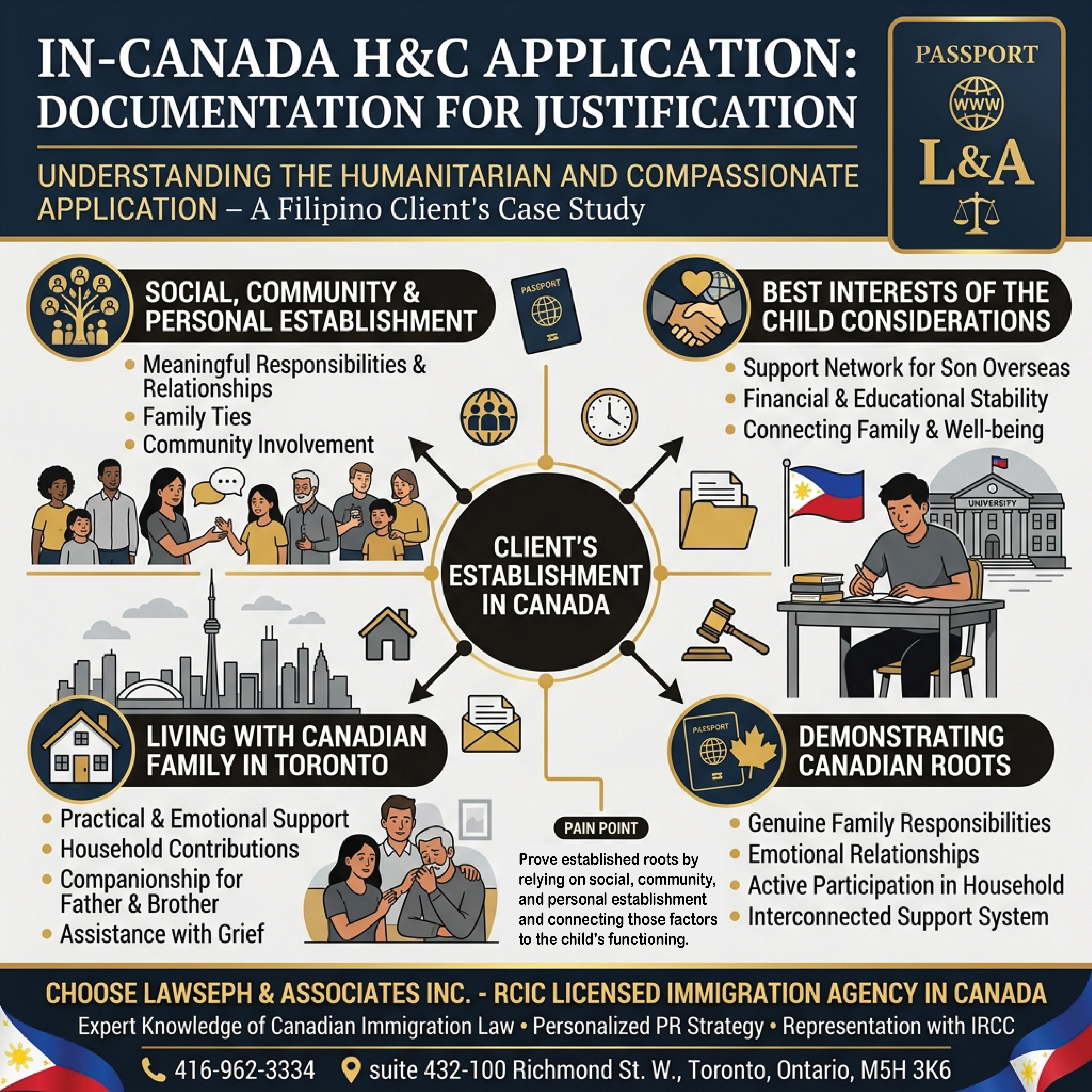
Instead, the application must demonstrate establishment through other meaningful factors, including the client’s family relationships, social connections, community involvement, personal responsibilities, and the role she performs within her Canadian household.
Best Interests of the Child Considerations
Another important consideration is how the best interests of the child can be incorporated into the H&C justification when the client’s child is already 18 years old and beginning post-secondary education in his home country.
The approach in this case is to demonstrate how the client’s establishment in Canada is connected to the functioning and well-being of her family, including her son overseas. The application should explain how the support network created through the client’s Canadian family relationships also contributes to the educational and financial stability of her son.
Demonstrating Social, Community, and Personal Establishment
For this client, Lawseph’s approach is to demonstrate Canadian establishment primarily through social, community, family, and personal factors rather than employment or educational history in Canada.
The objective is to provide evidence showing that the client has developed meaningful responsibilities and relationships in Canada and that these relationships have created an interconnected family support system.
Living With Canadian Family Members in Toronto
Our client currently lives in Toronto with her Canadian father and brother. Her presence in the household provides practical and emotional support to both family members.
She regularly assists with household responsibilities, including:
- Cooking meals;
- Cleaning and maintaining the household;
- Walking the family dog;
- Picking up groceries; and
- Providing companionship and emotional support.
These daily responsibilities help demonstrate that the client is not simply physically present in Canada. She has become an active participant in the functioning of the household and in the day-to-day lives of her Canadian family members.
Family Grief and Emotional Support
The client’s father’s wife has passed away. Since that loss, the client’s presence in the household has helped her father and brother process their grief and develop a new family and social dynamic within the home.
The father, son, and daughter regularly share meals, watch television, spend time with friends and family, and remember experiences they shared when their mother and wife was alive.
These activities may appear ordinary when considered individually, but together they help demonstrate the client’s continuing emotional role within the Canadian household and the importance of her presence to the family’s stability.
Financial and Educational Support for the Client’s Son Overseas
The client’s father has stable, well-paying employment in Canada, while her brother is completing post-secondary education in Canada.
The client’s father also sends financial support to the client’s son overseas to assist with his post-secondary education. This creates another connection between the client’s Canadian family establishment and the well-being of her son outside Canada.
Supporting documentation should therefore demonstrate not only the family relationships themselves, but also how the Canadian household provides practical, emotional, and financial support across the family unit.
Potential Impact of Removing the Client From Canada
The removal of our client from Canada could disrupt the balanced social and family network that has developed within the household.
The H&C application should therefore explain and document how the client’s departure could negatively affect her Canadian father and brother, while also affecting the broader support structure available to her son overseas.
The purpose of the supporting evidence is to demonstrate that the client’s establishment in Canada is based on genuine family responsibilities, emotional relationships, practical contributions, and an interconnected support system rather than simply the length of time she has physically remained in Canada.
Documenting the H&C Justification
For an H&C application involving circumstances such as these, supporting documentation should be organized so that each document helps demonstrate a specific aspect of the applicant’s establishment, family relationships, household responsibilities, emotional support, financial connections, and the consequences that removal could have on the family network.
A strong application should connect the documentary evidence directly to the humanitarian and compassionate circumstances being presented rather than submitting documents without explaining their significance.