

Entrepreneur Stream
The Ontario Immigrant Nominee Program (OINP) Entrepreneur Stream, which closed to new applications in late 2024 to adapt to economic changes, had strict limitations designed to ensure high-value investment and genuine, active management. These limitations focused on location, financial capacity, job creation, and specific ineligible business types.
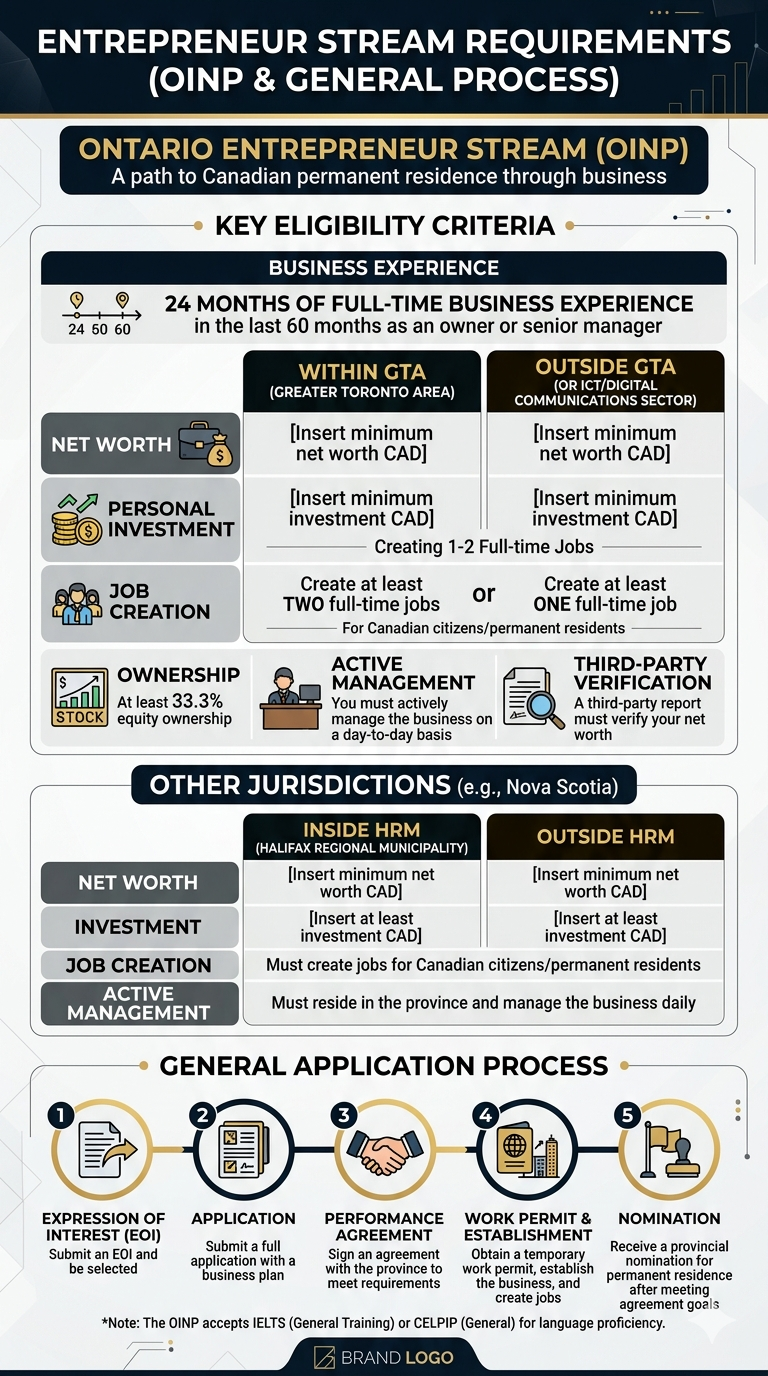
OINP Entrepreneur Stream
The OINP Entrepreneur Stream is Ontario’s business immigration pathway for experienced business owners or senior managers who want to start a new business or buy an existing business in Ontario and actively manage it.
1. Main Requirements for the Entrepreneur Stream
A. Business Experience Requirement
- You should have at least 24 months of full-time business experience in the last 60 months before applying.
- This experience is typically expected to be as either:
- a business owner, or
- a senior manager with significant decision-making authority.
B. Net Worth Requirement
- If the proposed business will be located inside the Greater Toronto Area (GTA), the minimum personal net worth is generally $800,000 CAD.
- If the proposed business will be located outside the GTA, the minimum personal net worth is generally $400,000 CAD.
- If the proposed business is in the ICT / digital communications sector, the minimum personal net worth is generally $400,000 CAD, regardless of location.
- Your net worth must be lawfully obtained and must be capable of verification.
C. Minimum Investment Requirement
- If the proposed business will be located inside the GTA, the minimum personal investment is generally $600,000 CAD.
- If the proposed business will be located outside the GTA, the minimum personal investment is generally $200,000 CAD.
- If the proposed business is in the ICT / digital communications sector, the minimum personal investment is generally $200,000 CAD, regardless of location.
- The investment must usually be directed toward expenditures essential to establishing or operating the business and not primarily toward passive investment or personal compensation.
D. Ownership Requirement
- You must generally control at least 33.3% of the equity in the business.
- You must play an active, ongoing role in managing the business from within Ontario.
E. Job Creation Requirement
- If the business will be located inside the GTA, you generally must create at least 2 permanent full-time jobs for Canadian citizens or permanent residents.
- If the business will be located outside the GTA, you generally must create at least 1 permanent full-time job for a Canadian citizen or permanent resident.
- If the business is in the ICT / digital communications sector, the job-creation threshold is generally 1 permanent full-time job.
F. Business Activity Requirement
- You must intend to actively manage the business in Ontario.
- The business must normally be a for-profit active business with a genuine commercial purpose.
- The business should create economic benefit to Ontario, such as job creation, regional development, innovation, or export potential.
- Passive or mainly investment-based business models are typically weak or ineligible.
G. New Business or Purchase of Existing Business
- You may generally either:
- start a new business, or
- buy an existing Ontario business.
- If buying an existing business, the business is generally expected to have been operating continuously for a substantial period before purchase.
- The purchase normally must involve a real transfer of ownership and the business must continue operating in a way that meets stream requirements.
H. Exploratory Visit
- An exploratory visit is commonly expected, especially if you are purchasing an existing business or where Ontario requests it during review.
- This helps support the credibility of the business concept and the applicant’s understanding of the Ontario market.
I. Language Requirement
- At the registration stage, there has historically been no minimum language test threshold to enter the process.
- However, after the business is established and before nomination, applicants are commonly expected to demonstrate at least CLB 4 in English or French.
J. Residency and Temporary Work Permit Stage
- This is generally a two-step business immigration process.
- If approved at the provincial stage, the entrepreneur is usually issued a work permit support letter after signing a performance agreement.
- The entrepreneur then comes to Ontario on a temporary work permit to implement the business plan before being nominated for permanent residence.
2. Step-by-Step Process
- Prepare the business concept, supporting documents, and financial records.
- Submit an Entrepreneur Stream Expression of Interest.
- If invited, submit the full Entrepreneur application within Ontario’s deadline.
- Attend an interview if requested by Ontario.
- If approved, sign a Performance Agreement with Ontario.
- Receive a work permit support letter and apply to IRCC for the temporary work permit.
- Come to Ontario and establish or purchase and operate the business.
- Meet the commitments in the Performance Agreement, then request provincial nomination.
- After nomination, apply for permanent residence with IRCC.
3. Applicant Document Checklist
Ontario still references an Entrepreneur Stream checklist in its document-checklist index. In practice, the file is usually structured into the categories below.
A. Identity and Civil Status Documents
- Passport bio page
- Passport pages showing visas and entry stamps
- Birth certificate, where applicable
- Marriage certificate or divorce documents, if relevant
- Dependent family member identity documents, if included
- Photographs as required by the application process
B. Business Experience Documents
- Company registration records
- Shareholder records
- Articles of incorporation or equivalent business formation documents
- Business licences and permits
- Employment records showing senior management role, where relevant
- Tax returns and corporate tax filings
- Audited or reviewed financial statements
- Payroll records
- Contracts, invoices, and proof of commercial activity
C. Net Worth Verification Documents
- Bank statements
- Investment account statements
- Real estate ownership documents
- Corporate ownership records
- Loan and liability records
- Tax records showing lawful accumulation of assets
- Third-party net worth verification report, where required by Ontario’s process
D. Business Concept and Business Plan Documents
- Detailed business plan
- Market research
- Competitor analysis
- Start-up or acquisition budget
- Revenue projections
- Hiring plan
- Operating plan for the first implementation period
- Explanation of how the business will benefit Ontario
E. Existing Business Purchase Documents, If Applicable
- Letter of intent to purchase
- Draft purchase agreement or signed sale agreement, where available
- Proof of current ownership
- Historical financial statements
- Payroll and employee records
- Business lease or real property documents
- Evidence that the business has been operating continuously
F. Exploratory Visit Documents, If Applicable
- Travel itinerary
- Boarding passes
- Hotel receipts
- Meeting notes with brokers, vendors, or local advisors
- Records of site visits
G. Interview and Performance Agreement Stage Documents
- Updated business concept records
- Clarification letters requested by Ontario
- Signed Performance Agreement
- Work permit support letter from Ontario
H. Nomination Stage Documents After Business Establishment
- Proof that the investment was actually made
- Proof of business operations in Ontario
- Payroll records showing required job creation
- Business bank statements
- Tax and remittance filings
- Lease agreements or business premises proof
- Language test results, if required at nomination stage
4. Forms You Should Expect to Use
- Entrepreneur Stream Expression of Interest
- Entrepreneur Stream full application through the OINP process after invitation
- Business plan / business concept submission
- Net worth verification authorization and report process
- Applicant Consent Form, where required by Ontario’s current checklist structure
- Performance Agreement
- Work permit support letter stage documents
- Representative authorization forms, if using counsel or a licensed representative
5. Payments, Fees, and Receipts
A. Ontario Fees
- The Entrepreneur Stream application fee is commonly reported as $3,500 CAD for the principal applicant.
- Older program materials and third-party summaries also refer to a separate Entrepreneur EOI / registration fee in some versions of the process. Verify current fee structure before filing.
- Ontario’s general payment guidance indicates online payment by major cards such as Visa, Visa Debit, Mastercard, and Mastercard Debit.
B. Ontario Receipt Records
- EOI or registration payment receipt, if applicable
- Full application payment confirmation
- Portal submission confirmation
- Interview or file-update correspondence from Ontario
- Any refund record, if Ontario returns the application
C. Federal Fees
- Temporary work permit fees payable to IRCC after the provincial approval stage
- Permanent residence processing fees after nomination
- Right of Permanent Residence Fee
- Biometrics fees, where applicable
6. Advantages of the Entrepreneur Stream
- Designed for business owners and investors, not employees.
- No traditional job offer is required.
- Can fit experienced entrepreneurs who do not qualify well under skilled worker streams.
- Direct economic contribution model through investment and job creation.
- Can be attractive for high-net-worth applicants who want more control over their own pathway.
- Outside-GTA and ICT business concepts have lower thresholds than GTA businesses.
7. Weaknesses and Risks of the Entrepreneur Stream
- Current availability is unclear because Ontario’s main active-stream page no longer lists it.
- Much higher financial barriers than worker, graduate, or Express Entry-linked streams.
- It is a two-step, performance-based process, so permanent residence is not immediate.
- High documentary burden, especially for net worth, source of funds, and business operations.
- Business risk is real: if the business does not meet performance commitments, nomination may fail.
- More interview and credibility scrutiny than most other OINP streams.
8. Comparison with Other Ontario Streams
| Factor | Entrepreneur Stream | Employer Job Offer Streams | Express Entry Streams | Masters / PhD Graduate Streams |
|---|---|---|---|---|
| Main applicant type | Business owner / senior manager | Worker with Ontario employer support | Skilled worker with Express Entry profile | Ontario graduate |
| Job offer required | No | Yes | No | No |
| Capital requirement | High | Low | Low | Low |
| Biggest strength | Control through own business activity | Employer support can strengthen file | Can be fast after nomination | No job offer needed |
| Biggest weakness | Capital risk plus performance risk | Employer dependence | Invitation / NOI dependence | Restricted to Ontario graduates |
9. Practical File Preparation Notes
- Verify first whether the stream is currently open and still using the same criteria.
- Prepare the source of funds package early.
- Do not rely on a weak or generic business plan.
- If purchasing a business, perform strong due diligence on payroll, tax history, liabilities, and ownership.
- Keep all receipts, confirmations, and interview communications.
- Build the file as both an immigration case and a commercial transaction case.
10. Conclusion
The OINP Entrepreneur Stream can be a powerful pathway for the right applicant: an experienced entrepreneur or senior manager with real capital, a credible Ontario business concept, and the ability to actively manage and grow a business in the province.
Its biggest strengths are flexibility and business control. Its biggest weaknesses are the high capital thresholds, the two-step performance-based structure, and the current uncertainty around public program availability. For most cases, success depends on careful due diligence, a strong business plan, clear proof of lawful funds, and realistic post-landing execution.
Why Choose Lawseph & Associates Inc. (RCIC-Licensed)
- Expert strategy: We validate MNI, model family size scenarios, and plan for intake timing.
- Compliance-first assembly: Forms, documents, and proofs curated to IRCC standards.
- Active file management: We respond quickly to IRCC requests and guide biometrics/medicals.
- Transparent pricing & timelines: No surprises—just a thorough, professional process.
Apply for PR with Expert Guidance