


Date: September 18, 2026
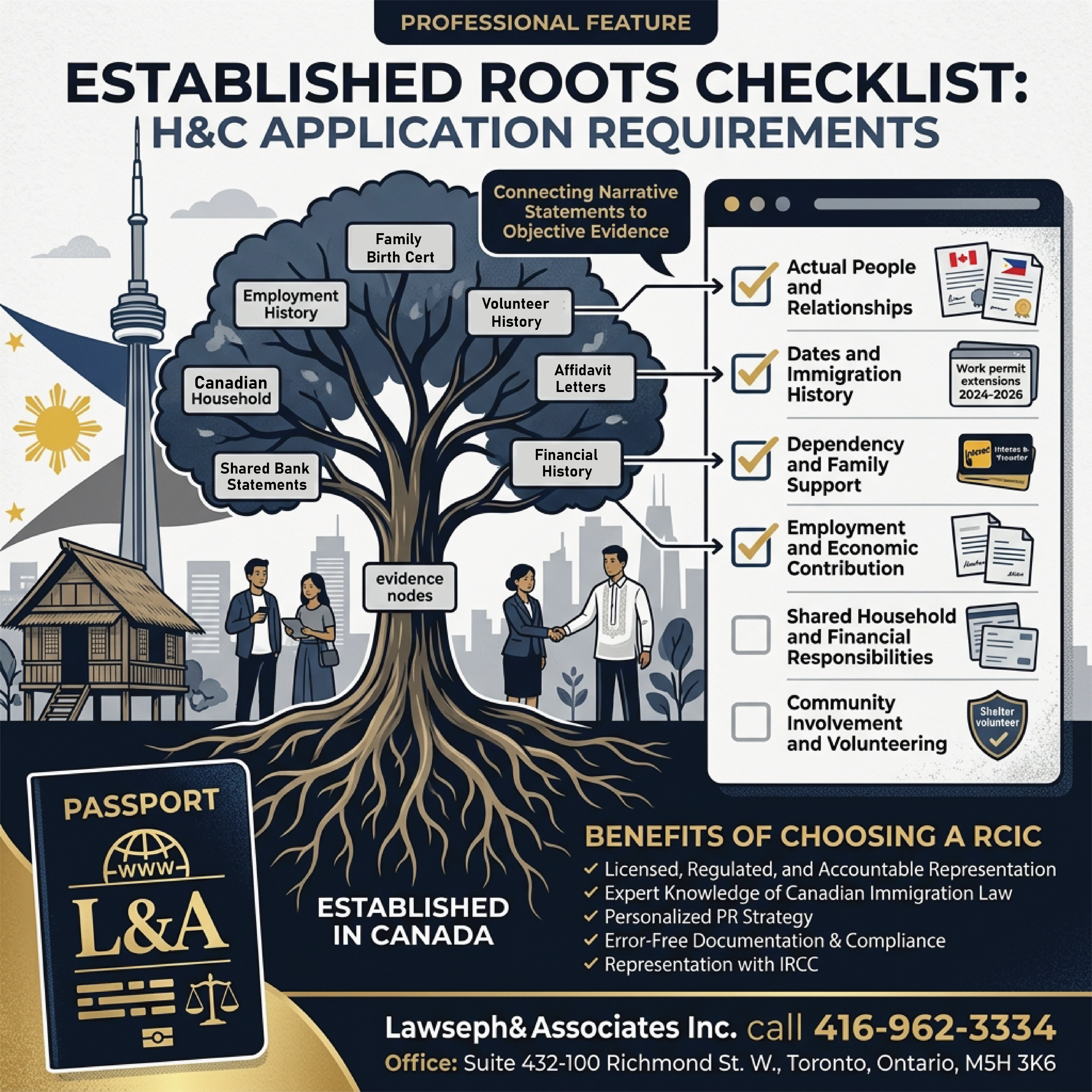
For an Humanitarian and Compassionate (H&C) application, the goal is to connect each important statement in the applicant’s narrative to objective documentary evidence wherever possible. This evidence can help substantiate and justify the claims made in the applicant’s IMM 5283 application and supporting submissions.
A practical evidence checklist for demonstrating established roots in Canada and potential hardship if required to return to the applicant’s home country can include evidence relating to:
- Actual People and Relationships
- Dates and Immigration History
- Dependency and Family Support
- Employment and Economic Contribution
- Establishment in Canada
- Country-of-Return Circumstances
Actual People and Relationships
Birth certificates for our Filipino client and her Canadian brother can help establish their family relationship through matching parental information recorded on the documents.
The brother’s marriage certificate can further establish the relationship between the applicant and her sister-in-law by documenting the marriage between the applicant’s brother and his wife.
Together, these civil-status documents can provide objective evidence supporting the identities and relationships of the family members discussed throughout the H&C application.
Dates and Immigration History
A collection of work permits and work permit extensions from 2024 through the time of application submission in 2026 can help document the applicant’s immigration history and duration of residence in Canada.
Where applicable, immigration documents showing extensions and applications submitted to maintain temporary resident status can demonstrate the applicant’s efforts to maintain lawful immigration status and comply with Canadian immigration requirements.
Organizing these documents chronologically can also help establish a clear timeline of the applicant’s life and establishment in Canada.
Dependency and Family Support
A collection of Interac e-Transfer records showing money sent to the client’s dependent son’s bank account overseas can help demonstrate that her son financially depends on income earned through his mother’s employment in Canada.
These records can help establish an ongoing pattern of financial support rather than relying solely on statements that the applicant provides financial assistance to her son.
Support Between the Applicant and Sister-in-Law
An affidavit from the applicant’s sister-in-law describing the impact of her husband’s death and the emotional support provided by our client can help demonstrate how the family unit relies on the applicant for emotional support and daily functioning.
An affidavit from our client describing her life since arriving in Canada and how she and her sister-in-law have processed the grief associated with the death of the client’s brother can further demonstrate how closely integrated they have become in each other’s lives.
Shared Household and Financial Responsibilities
Financial receipts and bank statements from our client and her sister-in-law showing payment of rent, utilities, groceries, and other household expenses can help demonstrate that they reside together and share financial responsibilities.
This evidence can also help demonstrate that the applicant’s establishment in Canada involves more than simply living in the country. It can show the development of an interconnected household and family support network.
Employment and Economic Contribution
Copies of Notices of Assessment (NOAs) relating to our client’s employment in Canada can provide objective evidence of employment income, tax filings, and economic participation during her period of residence in Canada.
These official financial documents can help corroborate the applicant’s employment history and demonstrate that she has participated in the Canadian economy.
Employer Reference Letters
Reference letters from current and previous employers can provide additional evidence of the applicant’s employment in Canada.
Strong employer letters can describe:
- The applicant’s position and occupation;
- Dates of employment;
- Hours of work;
- Employment duties and responsibilities;
- Salary or hourly compensation;
- The applicant’s reliability and contribution to the workplace; and
- The employer’s continuing need for the applicant’s work, where applicable.
This evidence can help establish the applicant’s employment history while demonstrating the practical role she has developed within her workplace.
Establishment in Canada
Establishment evidence should demonstrate how the applicant’s life has become rooted in Canada over time. Employment, financial responsibilities, family relationships, community involvement, friendships, and other social connections can collectively demonstrate the extent of the applicant’s integration into Canadian society.
Employment History
A detailed record of employment history can demonstrate that our client has developed economic roots in Canada and relies on Canadian employment as the primary source of income for herself, her dependent son, and, where applicable, her household in Canada.
Stable employment over an extended period can therefore form an important part of the overall evidence of establishment.
Tax Filings and Financial Records
A record of Canadian tax filings can provide objective evidence of the applicant’s employment income and financial activity over time.
Notices of Assessment, T4 slips, pay statements, bank records, and other financial documents can be organized chronologically to demonstrate the consistency and progression of the applicant’s economic establishment in Canada.
Community Involvement and Volunteering
Evidence of participation in community organizations, volunteer activities, religious organizations, charities, neighbourhood organizations, or other community groups can help demonstrate social integration.
For example, our client volunteered at a shelter in her neighbourhood. This activity demonstrates community participation while also showing how she developed social connections in Canada. Our client met her Canadian boyfriend through her volunteer work at the shelter.
Friends, Family and Social Network
Letters from friends and family can help demonstrate that the applicant has developed a meaningful social network in Canada.
These letters are particularly useful when they provide specific examples of how the applicant participates in the writer’s life rather than simply stating that the applicant is a good person or friend.
For example, our client met her boyfriend through volunteering at the local shelter, and their relationship subsequently became an important part of their lives in Canada.
A detailed letter from the boyfriend describing the history and development of their relationship, their activities together, their future plans, and the emotional support they provide to one another can help demonstrate additional social and emotional roots in Canada.
Country-of-Return Circumstances
An H&C application should not only document the applicant’s establishment in Canada. Where relevant to the applicant’s circumstances, supporting evidence can also explain the conditions the applicant would face if required to return to the Philippines.
Employment and Economic Prospects
Copies of the applicant’s highest educational credentials and previous employment history can help document her professional and economic circumstances before coming to Canada.
Previous Philippine tax filings, employment records, income records, and other financial documents may provide objective evidence concerning the applicant’s historical employment and income in the Philippines.
This information can then be compared with evidence of the applicant’s employment stability, income, responsibilities, and economic establishment developed in Canada.
Housing and Living Circumstances
Property records, rental agreements, lease agreements, or other evidence concerning the applicant’s available accommodation in the Philippines can help document the living circumstances that would be available if she were required to return.
Where the applicant would have limited or unstable accommodation, the supporting documents should clearly explain and substantiate those circumstances.
Available Family Support in the Philippines
Death certificates for deceased siblings or other immediate family members in the Philippines can help document the loss or absence of members of the applicant’s former family support network.
Birth certificates and other records concerning elderly relatives may also help identify the family members who remain in the Philippines. Where age, dependency, or other documented circumstances limit their ability to provide meaningful assistance to the applicant, supporting evidence should explain those circumstances.
If the applicant has few or no close family members remaining in the Philippines, documentary evidence establishing the family structure can help support the applicant’s explanation of the limited family support that would be available following a return.
Connecting the Evidence to the H&C Narrative
The strength of the supporting documentation is not simply the number of documents submitted. The evidence should correspond directly to the important facts and circumstances described in the applicant’s H&C narrative.
Whenever possible, an important statement should be supported by objective documentation. For example, employment can be supported by work permits, employer letters, pay statements, T4 slips, and Notices of Assessment. Financial dependency can be supported by bank statements and transfer records. Family relationships can be supported by birth and marriage certificates. Community establishment can be supported by volunteer records and letters from people who have direct knowledge of the applicant’s involvement.
When these documents are organized around the applicant’s personal history, relationships, establishment in Canada, and circumstances upon return, they can provide a clearer evidentiary foundation for the humanitarian and compassionate considerations described in the application.
Established Roots Evidence Checklist
- Birth certificates establishing family relationships
- Marriage certificates establishing extended family relationships
- Current and previous work permits
- Immigration extension and status documents
- Interac e-Transfer and remittance records
- Bank statements
- Affidavits from family members
- Shared rent, utility, grocery, and household expense records
- Notices of Assessment (NOAs)
- T4 slips and pay statements
- Employer reference letters
- Employment history records
- Volunteer and community organization records
- Letters from friends, family, and community members
- Evidence of a relationship with a boyfriend or partner, where relevant
- Educational credentials and previous employment records
- Philippine tax and income records, where relevant
- Property, rental, or accommodation records in the Philippines
- Death certificates documenting deceased immediate family members
- Documents establishing the remaining family support network in the Philippines