

Regional Economic Development through Immigration (REDI)
Regional Economic Development through Immigration Quiz
The Regional Economic Development through Immigration (REDI) pilot is an Ontario Immigrant Nominee Program (OINP) initiative designed to attract skilled foreign workers to specific rural and northern Ontario communities. It offers a pathway to Canadian permanent residence for workers with job offers in sectors such as health care, technology, and trades.
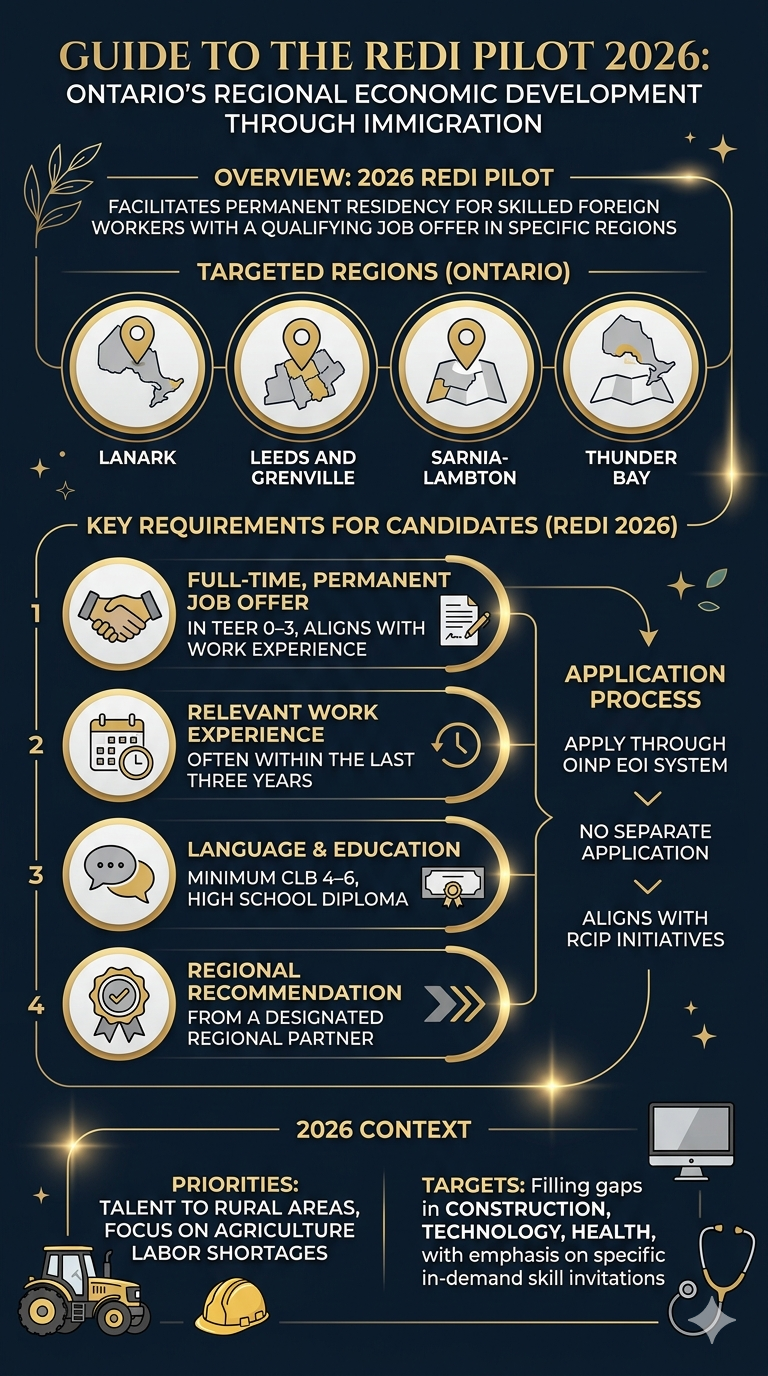
Ontario REDI Pilot (Regional Economic Development through Immigration)
The Regional Economic Development through Immigration (REDI) initiative is not a standalone OINP stream. It is a targeted pilot that works through Ontario’s existing Employer Job Offer streams:
- Employer Job Offer: Foreign Worker Stream
- Employer Job Offer: International Student Stream
- Employer Job Offer: In-Demand Skills Stream
1. What REDI Is
Ontario’s 2025 and 2026 program updates show that REDI invitations were issued under the Employer Job Offer: Foreign Worker, International Student, and In-Demand Skills streams, not under a separate stream. Ontario’s Employer Portal page also confirms that all Employer Job Offer applications use the same employer-led process through the portal. In practice, REDI is a regional targeting mechanism layered on top of those three streams. :contentReference[oaicite:0]{index=0}
2. Participating Communities
Ontario’s 2025 launch materials described REDI as a pilot aimed at bringing up to 800 additional workers to participating regional communities. Public Ontario-linked reporting around the launch identified the participating communities as Lanark, Leeds and Grenville, Sarnia-Lambton, and Thunder Bay. More recent Ontario invitation updates in 2026 specifically referenced invitations for candidates with job offers in Lanark or Leeds and Grenville. Because community targeting has clearly varied over time, applicants should always verify the most recent draw details before filing. :contentReference[oaicite:1]{index=1}
3. Core REDI Eligibility Requirements
A. General REDI Requirements
- You must qualify under one of the three Employer Job Offer streams.
- You must have a qualifying job offer from an employer in a REDI community.
- You must register an Expression of Interest (EOI) based on the employer-submitted job offer.
- You must receive an Invitation to Apply (ITA) in a REDI-targeted draw.
- Recent REDI draws in 2025 and 2026 required candidates to be currently residing in Canada, usually with a valid work or study permit.
Ontario’s updates for REDI draws in 2025 and 2026 repeatedly state that candidates were invited under the existing Employer Job Offer streams and had to be in Canada, with later 2026 draws explicitly saying candidates needed a valid work or study permit and a job offer in Lanark or Leeds and Grenville. :contentReference[oaicite:2]{index=2}
B. Base Stream Requirement: Foreign Worker Stream
- Full-time, permanent Ontario job offer in a skilled occupation
- Generally at least 2 years of work experience in the same occupation / NOC within the qualifying period
- Valid Ontario licence or authorization if the occupation is regulated
- Intention to reside in Ontario
- Employer must meet Employer Job Offer stream employer requirements
Ontario’s official Foreign Worker applicant checklist and stream materials show that this stream is work-experience based and requires mandatory supporting documents such as identity, status, licensing where applicable, pay slips if already working in the same role, work-history documents, résumé, and proof of EOI factors. :contentReference[oaicite:3]{index=3}
C. Base Stream Requirement: International Student Stream
- Full-time, permanent Ontario job offer in an eligible skilled occupation
- Eligible Canadian credential meeting Ontario’s education rules
- Application within the stream’s education timing limits
- Valid Ontario licence or authorization if required
- Intention to reside in Ontario
- Employer must meet Employer Job Offer stream employer requirements
Ontario’s International Student stream checklist and stream page show that this pathway is built on an eligible credential plus a qualifying job offer, rather than the work-experience model used in the Foreign Worker stream. :contentReference[oaicite:4]{index=4}
D. Base Stream Requirement: In-Demand Skills Stream
- Full-time, permanent Ontario job offer in an eligible in-demand occupation
- At least 9 months of cumulative paid full-time work experience, or equivalent, in Ontario in the same in-demand occupation within the 3 years before application
- CLB 4 language ability
- At least a Canadian high school diploma or equivalent foreign credential
- Valid licence or authorization if required
- Intention to reside in Ontario
Ontario’s official In-Demand Skills stream page states the 9-month Ontario work-experience rule, the same-NOC requirement, the need for legal work in Ontario, and the licensing requirement where applicable. :contentReference[oaicite:5]{index=5}
4. Employer-Side REDI Requirements
REDI uses the same employer-led process as all Employer Job Offer streams. Since July 2, 2025, Ontario requires all Employer Job Offer stream position approvals to be submitted through the Employer Portal. The employer must create the job offer first, the employee-applicant must register an EOI within 30 days, and if invited, the employer must submit the position approval application within 14 days. :contentReference[oaicite:6]{index=6}
- The employer must submit the job offer in the Employer Portal first.
- The candidate must register the EOI within 30 calendar days of that job offer.
- If invited, the employer must apply for approval of the employment position within 14 calendar days.
- If the employer misses that deadline, the application is withdrawn and a new job offer must be created.
5. REDI Application Process
- The employer creates and submits a job offer in the Employer Portal.
- The applicant receives the job-offer information and registers an EOI.
- The applicant waits for a REDI-targeted invitation.
- If invited, the employer submits the application for approval of the employment position within 14 days.
- The applicant submits the OINP application and payment within 17 days of the invitation.
- If approved, the applicant receives an Ontario nomination and then applies to IRCC for permanent residence.
Ontario’s Employer Portal page is explicit that the employee-applicant must register the EOI within 30 days, the employer must apply within 14 days after invitation, and the employee-applicant has a total of 17 days from the invitation date to submit the application. :contentReference[oaicite:7]{index=7}
6. Documents Required
Because REDI is not a standalone stream, there is no separate REDI applicant checklist. You use the checklist for the underlying Employer Job Offer stream, plus evidence showing the qualifying regional job offer and any draw-specific conditions. Ontario’s checklist index and stream-specific checklist pages support this structure. :contentReference[oaicite:8]{index=8}
A. Typical Applicant Documents
- Applicant Consent Form
- Identity documents
- Status documents in Canada
- Licensing / authorization documents, if applicable
- Pay slips, where required by the underlying stream
- Work history documents, where required by the underlying stream
- Education documents, where required by the underlying stream
- Language test documents, where required by the underlying stream
- Résumé
- EOI factor evidence
- Optional supporting documents
Ontario’s Foreign Worker checklist summary lists the core categories as Applicant Consent Form, identity, status, licensing, pay slips, work history, résumé, EOI selection factors, and optional documents. The International Student and In-Demand Skills streams use similar checklist structures, but with stream-specific supporting evidence such as education and language where applicable. :contentReference[oaicite:9]{index=9}
B. Typical Employer Documents
- Application for Approval of Employment Position
- Employer form / employer portal records
- Business registration or incorporation documents
- CRA documents
- Financial statements or proof of revenue
- Payroll records
- Proof of employee counts
- Business premises documents
- Job offer details
- Any additional stream-specific or portal-requested records
Ontario’s Employer Job Offer employer checklist confirms that the employer side remains document-heavy and applies across the Employer Job Offer family of streams, which is exactly the family REDI uses. :contentReference[oaicite:10]{index=10}
7. Forms and Portal Items
- Employer Portal job offer submission
- Expression of Interest registration
- Application for Approval of Employment Position
- Applicant Consent Form
- OINP e-Filing Portal application
- Representative authorization documents, if applicable
Ontario’s 2025 updates specifically warned that Employer Job Offer applications must include the updated Application for Approval of Employment Position / Employer Form and that older forms can result in the application being returned as incomplete with the fee refunded. :contentReference[oaicite:11]{index=11}
8. Payments, Fees, and Receipts
A. OINP Fee
- The general OINP application fee cited on Ontario’s application page is $1,500 CAD.
- Ontario says it accepts Visa, Visa Debit, Mastercard, and Mastercard Debit.
Ontario’s application page currently states that the application fee is $1,500 and lists the accepted payment methods above. :contentReference[oaicite:12]{index=12}
B. Receipts and Payment Records
- Portal payment confirmation
- Application submission confirmation
- Employer Portal records
- Any refund notice, if Ontario returns the application as incomplete
- Federal IRCC fee receipts later at the permanent residence stage
Ontario’s 2025 updates note that incomplete Employer Job Offer applications can be returned and the fee refunded, which makes receipt retention especially important in REDI files. :contentReference[oaicite:13]{index=13}
9. Advantages of REDI Compared to Other OINP Options
- Regional targeting advantage: REDI can improve invitation chances for candidates with job offers in participating communities.
- No separate stream to learn: it uses existing Employer Job Offer streams and their established criteria.
- Useful for regional employers: it is designed to direct nominations toward communities facing labour shortages.
- Helpful for candidates with lower EOI competitiveness outside targeted draws: regional targeting may create opportunities that do not exist in general invitations.
Ontario’s public messaging around REDI emphasized rural and northern labour shortages and additional regional immigration support, while the draw updates show the pilot is used to issue targeted invitations under the Employer Job Offer streams. :contentReference[oaicite:14]{index=14}
10. Weaknesses and Risks of REDI Compared to Other Streams
- Not a standalone stream: if the base stream does not fit, REDI does not help.
- Regional restriction: the employer must be in a participating community.
- Draw dependence: you still need a targeted invitation.
- Employer dependence: because REDI sits on top of Employer Job Offer streams, employer cooperation remains critical.
- Changing draw conditions: communities and conditions referenced in draws have changed over time.
Ontario’s 2025 and 2026 updates show exactly this pattern: REDI invitations were targeted, region-specific, and in recent rounds limited to candidates already in Canada with valid temporary status. :contentReference[oaicite:15]{index=15}
11. Comparison with Other OINP Pathways
| Factor | REDI Pilot | Regular Employer Job Offer Streams | Express Entry OINP Streams | Masters / PhD Graduate Streams |
|---|---|---|---|---|
| Standalone stream? | No | Yes | Yes | Yes |
| Job offer needed? | Yes | Yes | Usually no | No |
| Regional targeting? | Yes | Not necessarily | Usually occupation / profile targeting | EOI-based, not regional pilot-based |
| Main strength | Better odds for eligible regional employer files | Wider employer-base opportunities | No employer needed in many cases | Ontario graduate-focused |
| Main weakness | Very location-specific and invitation-dependent | Employer dependence | NOI dependence and stronger profile requirements | Limited to Ontario graduates |
12. Practical Filing Notes
- Check first whether the client actually qualifies under Foreign Worker, International Student, or In-Demand Skills.
- Confirm the employer’s worksite is in a currently targeted REDI community.
- Save all Employer Portal, EOI, and payment receipts immediately.
- Watch the deadline chain carefully: 30 days for EOI registration after job offer creation, 14 days for employer approval filing, and 17 days for the employee-applicant filing after invitation.
- Do not treat REDI as a shortcut around weak eligibility. It is a targeting tool, not a substitute stream.
13. Conclusion
The REDI pilot is best understood as a regional invitation strategy inside Ontario’s Employer Job Offer system, not as a separate immigration stream. Its main benefit is that it can improve selection prospects for applicants with strong employer-supported cases in participating communities. Its main weakness is that it still depends entirely on the underlying stream requirements, employer cooperation, regional targeting, and the timing of provincial invitations.
Why Choose Lawseph & Associates Inc. (RCIC-Licensed)
- Expert strategy: We validate MNI, model family size scenarios, and plan for intake timing.
- Compliance-first assembly: Forms, documents, and proofs curated to IRCC standards.
- Active file management: We respond quickly to IRCC requests and guide biometrics/medicals.
- Transparent pricing & timelines: No surprises—just a thorough, professional process.
Apply for PR with Expert Guidance