

Rural Community Immigration Pilot (RCIP)
Rural Community Immigration Pilot Quiz
The Rural Community Immigration Pilot (RCIP) is a federal economic immigration program in Canada launched in January 2025 to help fill labour shortages in rural and remote communities. It is an employer-driven permanent residence pathway that replaced the previous Rural and Northern Immigration Pilot (RNIP).
Rural Community Immigration Pilot (RCIP)
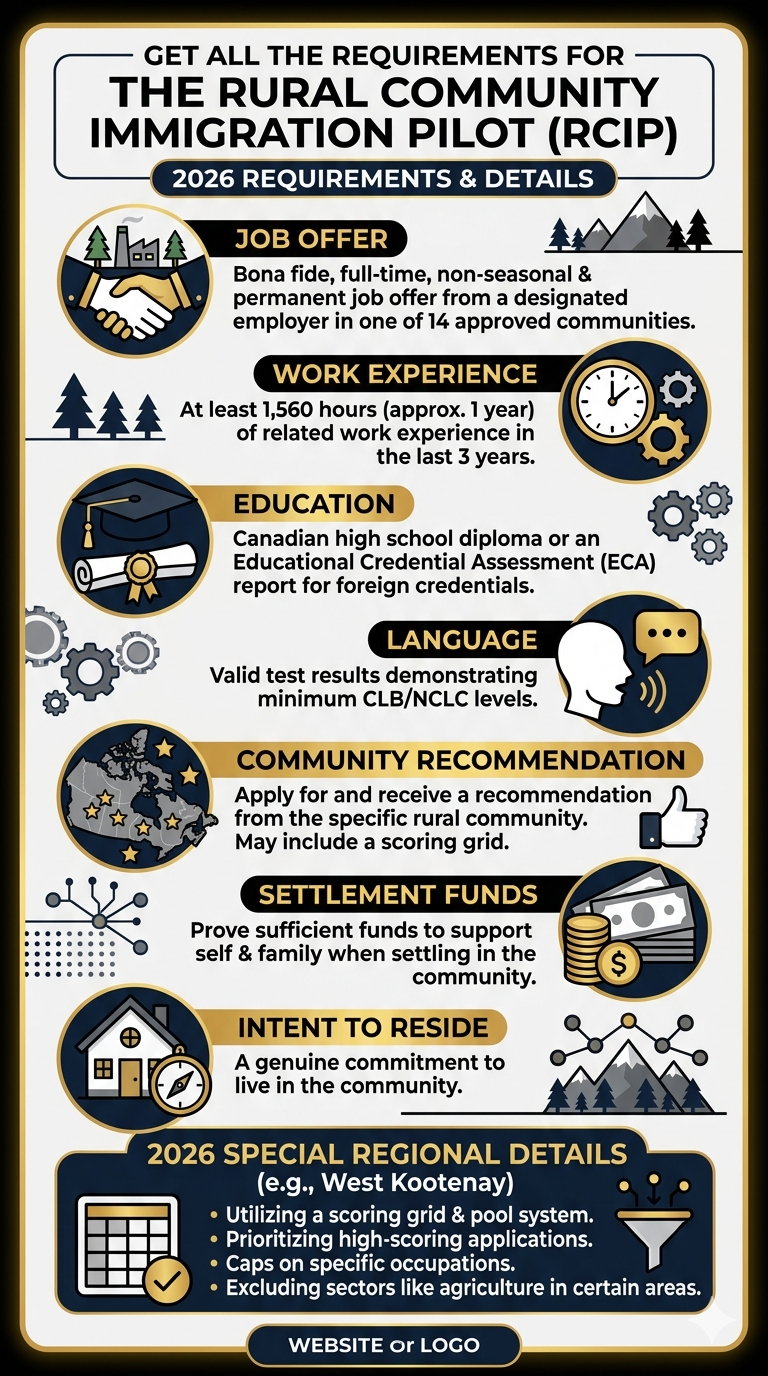
The Rural Community Immigration Pilot (RCIP) is a federal permanent residence pathway for skilled workers who want to work and settle in participating rural and remote communities in Canada. It replaced the former Rural and Northern Immigration Pilot and is designed to help designated employers in participating communities fill jobs they cannot fill locally.
1. Main Requirements for the Rural Community Immigration Pilot
A. Valid Job Offer from a Designated Employer
- You must have a valid job offer before you apply.
- The job offer must come from a designated employer in a participating RCIP community.
- The employer must be approved by the community to hire through the pilot.
- The job must also meet the pilot requirements and community priority rules.
B. Community Recommendation
- After you receive a valid job offer, the employer sends the community recommendation application to the community.
- The community reviews whether:
- the job offer is genuine,
- the job is in a priority sector or occupation, and
- you meet the pilot requirements.
- You can only apply for permanent residence after the community recommends you.
C. Work Experience Requirement
- You generally need at least 1 year (1,560 hours) of related paid work experience in the last 3 years.
- The work must:
- be paid work,
- not be self-employment,
- match the actions in your NOC description,
- include most of the main duties, and
- be in an eligible TEER relationship to your job offer.
General TEER matching rule:
- If your job offer is TEER 0 or 1, your work experience can be in TEER 0, 1, 2 or 3.
- If your job offer is TEER 2, your work experience can be in TEER 1, 2, 3 or 4.
- If your job offer is TEER 3 or 4, your work experience can be in TEER 2, 3 or 4.
- If your job offer is TEER 5, your work experience must be in the same 5-digit NOC code.
D. Work Experience Exemption for Certain International Graduates
- You may not need to meet the work experience requirement if you graduated from a public post-secondary school in the community and meet the RCIP study conditions.
- For a program of 2 years or longer, you must generally:
- have studied full-time for the entire program,
- have obtained the credential no more than 18 months before applying, and
- have been in the community for at least 16 of the last 24 months while studying.
- For a master’s degree or higher of 2 years or less, you must generally:
- have studied full-time for the entire degree,
- have obtained the degree no more than 18 months before applying, and
- have been in the community for the length of your studies.
E. Language Requirement
- Your required language score depends on the TEER of the job offer:
- TEER 0 or 1: minimum CLB 6
- TEER 2 or 3: minimum CLB 5
- TEER 4 or 5: minimum CLB 4
- You must take an approved language test and submit results that are less than 2 years old when you apply.
F. Education Requirement
- You need either:
- a Canadian secondary school diploma, or
- a recognized Canadian post-secondary certificate, diploma, or degree, or
- a valid Educational Credential Assessment (ECA) showing your foreign education is equivalent.
- For certain regulated occupations, special assessment bodies may be required instead of a general ECA.
G. Settlement Funds Requirement
- You must prove you have enough money to support yourself and your family after arriving in Canada.
- You do not need to show proof of funds if you are already working in Canada with a valid work permit.
- Acceptable proof can include:
- bank account statements,
- bank drafts,
- cheques, and
- money orders.
H. Passport and Status Requirement
- You must hold a valid regular passport.
- If you are living in a country other than the one on your passport, you must also include proof of your legal status there.
I. Participating Communities
IRCC currently lists these rural participating communities:
- Pictou County, Nova Scotia
- North Bay, Ontario
- Sudbury, Ontario
- Timmins, Ontario
- Sault Ste. Marie, Ontario
- Thunder Bay, Ontario
- Steinbach, Manitoba
- Altona/Rhineland, Manitoba
- Brandon, Manitoba
- Moose Jaw, Saskatchewan
- Claresholm, Alberta
- West Kootenay, British Columbia
- North Okanagan Shuswap, British Columbia
- Peace Liard, British Columbia
2. Step-by-Step RCIP Application Process
- Choose a participating RCIP community.
- Find a job offer from a designated employer in that community.
- The employer submits the community recommendation application to the community.
- The community reviews the case and, if approved, issues a recommendation.
- You apply online for permanent residence through the Permanent Residence Portal.
- You upload the required forms, checklist, documents, and fee receipt.
- If approved, you complete the final permanent residence process with IRCC.
3. Required Forms
RCIP uses both digital forms inside the PR portal and PDF forms uploaded with the application.
A. Digital Forms in the Portal
- Generic Application Form for Canada (IMM 0008)
- Schedule A – Background / Declaration (IMM 5669)
- Additional Family Information (IMM 5406)
- Supplementary Information – Your Travels (IMM 5562)
B. PDF Forms You Upload
- Document Checklist – Rural Community Immigration Pilot (IMM 0246)
- Offer of Employment to a Foreign National – Rural Community Immigration Pilot (IMM 0247)
- Schedule 1 – Rural Community Immigration Pilot (IMM 0248)
- Recommendation from the Designated Economic Development Organization – Rural Community Immigration Pilot (IMM 0249)
C. Additional Forms If Applicable
- Use of a Representative (IMM 5476)
- Authority to Release Personal Information to a Designated Individual (IMM 5475)
- Statutory Declaration of Common-law Union (IMM 5409)
- Separation Declaration for Minors Travelling to Canada (IMM 5604)
4. Document Checklist and Supporting Documents
The official checklist is IMM 0246. IRCC says you must use the checklist, complete it, and upload it with your online application.
A. Core Supporting Documents
- Proof of language proficiency
- Proof of education
- Proof of settlement funds, if required
- Proof of relevant work experience
- Passport and travel documents
- Identity and civil status documents
- Photo(s)
- Fee payment receipt
B. Work Experience Documents
- Employer reference letters showing:
- employment dates,
- main duties,
- NOC code if known,
- salary and benefits,
- hours worked per week, and
- employer contact information.
- Work contracts
- Pay stubs
- T4 slips and Notices of Assessment, if applicable
- Copy of your most recent Canadian work permit, if you have one
C. Identity and Civil Status Documents
- Birth certificates
- Name-change documents, if applicable
- Marriage certificates
- Divorce, annulment, or death certificates, if applicable
- National ID cards or family registry records, if applicable
D. Police Certificates and Photos
- Police certificates are generally required for countries where you have lived for 6 months or more since age 18.
- You need one recent immigration photo for yourself and each family member, even if they are not accompanying you.
E. Translation and Certified Copy Rules
- Documents not in English or French must include:
- a certified translation, and
- a scan of the original document or certified photocopy used for translation.
- Family members and immigration representatives cannot translate your documents.
5. Payments, Fees, and Receipts
A. Government Fees
- IRCC currently lists RCIP fees as from $1,525 CAD.
- You must pay your fees online.
- You must pay:
- processing fees,
- the Right of Permanent Residence Fee before approval, and
- the biometrics fee, if required.
B. Other Common Costs
- Language test fees
- Educational Credential Assessment fees
- Police certificate fees
- Medical exam fees
- Document translation and notarization costs
C. Receipt Requirements
- IRCC says you should print or save a PDF copy of the fee receipt page.
- IRCC also emails a copy of the receipt.
- You must upload the fee receipt with your application.
6. Advantages of the Rural Community Immigration Pilot
- Community-based selection: applicants with a genuine regional job offer may have a stronger path than under larger competitive federal pools.
- No LMIA needed for the community recommendation stage.
- Accessible language thresholds for lower-TEER jobs compared with some Express Entry pathways.
- International graduate exemption may remove the work experience requirement for some local graduates.
- Good fit for employers in smaller communities that need workers and are willing to support settlement.
7. Weaknesses and Risks of the Rural Community Immigration Pilot
- Very location-specific: you must work in a participating community and for a designated employer.
- Community recommendation required: a job offer alone is not enough.
- Employer designation and local priority rules matter: not every employer or occupation will qualify.
- Work experience rules are strict unless you qualify for the local-graduate exemption.
- Settlement expectation is real: this pilot is designed for people who truly plan to live in the community, not just use it as a landing point.
8. Comparison with Other Immigration Pathways
| Factor | RCIP | Express Entry | OINP Employer Job Offer Streams | Atlantic Immigration Program |
|---|---|---|---|---|
| Job offer required | Yes | Usually no | Yes | Yes |
| Community recommendation needed | Yes | No | No | Settlement plan and employer endorsement, but not this exact model |
| Regional restriction | High | Low | Ontario-only | Atlantic provinces only |
| Main strength | Community-driven PR path for rural employers and workers | Large national system with no required employer in many categories | Strong provincial employer-backed option | Employer-supported Atlantic PR pathway |
| Main weakness | Must fit the exact community, employer, and recommendation rules | High competition and CRS pressure | Employer dependence and provincial quotas | Restricted to Atlantic Canada |
9. Practical Filing Notes
- Check the community website first to confirm employer designation rules, priority occupations, and local process details.
- Make sure the job offer, work experience, and NOC/TEER match are consistent.
- Collect the community recommendation early because you cannot file without it.
- Save every portal record, recommendation letter, and fee receipt immediately.
- If relying on the graduate exemption, make sure the school, study period, and timing rules are documented clearly.
10. Conclusion
The Rural Community Immigration Pilot is one of the most practical federal immigration options for workers who have a real rural employer, a community recommendation, and a genuine intention to settle long-term in a participating community. Its strongest advantage is that it is tailored to regional labour shortages and can be more accessible than large national competitive systems. Its biggest weakness is that it is highly community-specific and document-sensitive.
Why Choose Lawseph & Associates Inc. (RCIC-Licensed)
- Expert strategy: We validate MNI, model family size scenarios, and plan for intake timing.
- Compliance-first assembly: Forms, documents, and proofs curated to IRCC standards.
- Active file management: We respond quickly to IRCC requests and guide biometrics/medicals.
- Transparent pricing & timelines: No surprises—just a thorough, professional process.
Apply for PR with Expert Guidance